
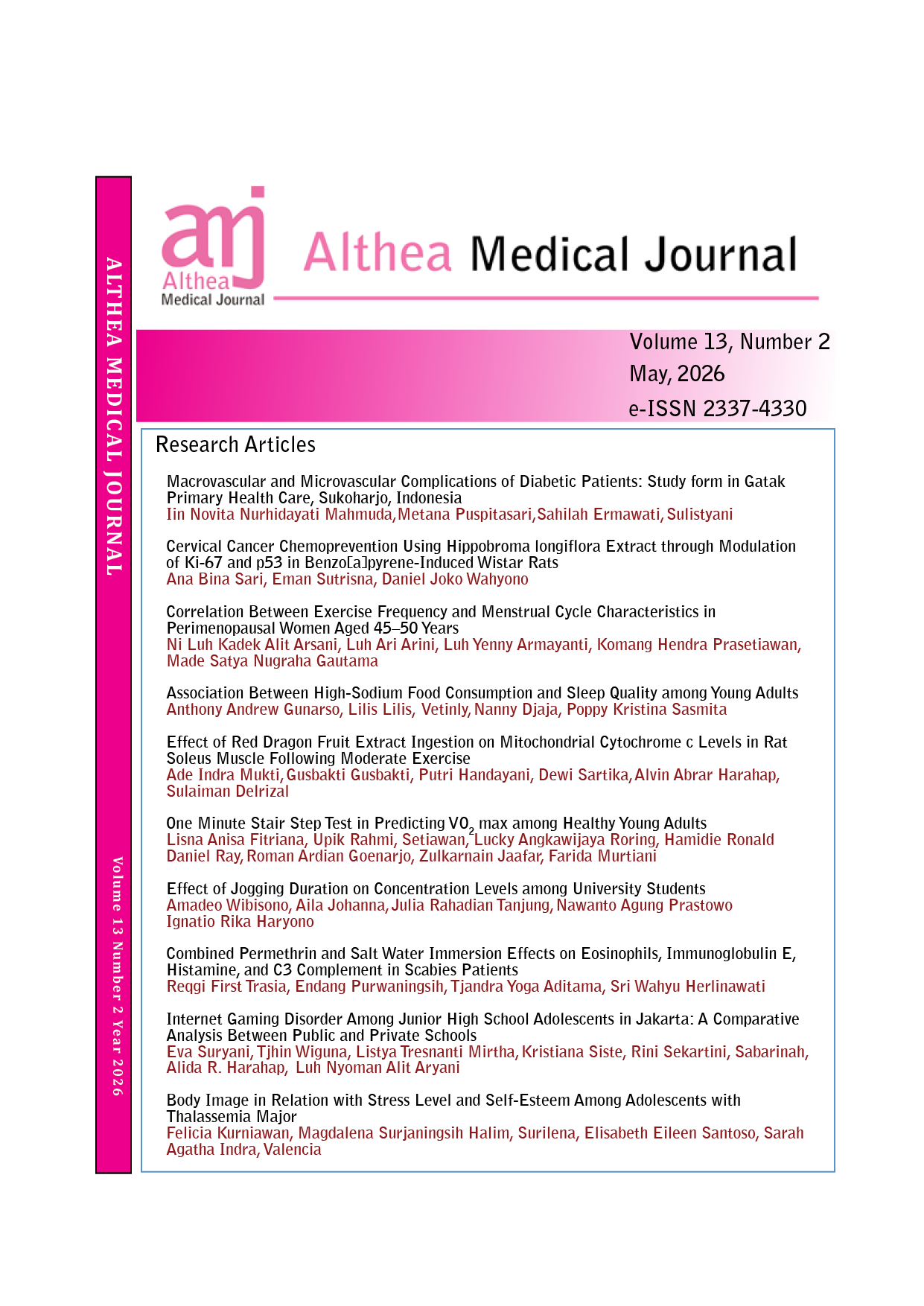
Internet Gaming Disorder Among Junior High School Adolescents in Jakarta: A Comparative Analysis Between Public and Private Schools
DOI:
https://doi.org/10.15850/amj.v13n2.4784Keywords:
Adolescent, internet gaming disorder, private school, public school, school-based preventionAbstract
Background: The increasing availability of mobile games and expandinng access to devices have contributed to the growing prevalence of Internet Gaming Disorder (IGD), particularly among adolescents. The IGD is associated with impaired well-being and functioning, including sleep, psychological, academic, and social problems. However, evidence regarding effective school-based interventions remains limited. This study aimed to explore the prevalence of IGD among junior high school students in public and private schools in Jakarta, Indonesia.
Methods: An analytic observational study with a cross-sectional design was conducted among 2,320 junior high school students from January to August 2025. Demographic data were collected using a basic questionnaire, and IGD was assessed using the Internet Gaming Disorder Test-10 (IGDT-10). Data were analyzed using the Chi-square test and Mann–Whitney test with SPSS version 23.0
Results: The prevalence of Internet Gaming Disorder (IGD) among junior high school adolescents in Jakarta was 2.2%. In private school, IGD was significantly associated with duration of gaming ≥4 hours/day and male gender, whereas in public school, IGD was significantly associated with the use of multiple gaming devices.
Conclusions: The prevalence of IGD among junior high school students in Jakarta was 2.2%. Factors associated with IGD varied between public and private schools, suggesting that prevention strategies should be tailored to the school context. Early identification of excessive gaming behaviors may support adolescent well-being and healthy development.
Downloads
References
- Meng SQ, Cheng JL, Li YY, Yang XQ, Zheng JW, Chang XW, et al. Global prevalence of digital addiction in general population: A systematic review and meta-analysis. Clin Psychol Rev. 2022;92:102128. doi:10.1016/j.cpr.2022.102128
- King DL, Chamberlain SR, Carragher N, Billieux J, Stein D, Mueller K, et al. Screening and assessment tools for gaming disorder: A comprehensive systematic review. Clin Psychol Rev. 2020;77:101831. doi:10.1016/j.cpr.2020.101831
- Paulus FW, Ohmann S, von Gontard A, Popow C. Internet gaming disorder in children and adolescents: a systematic review. Dev Med Child Neurol. 2018;60(7):645–59. doi:10.1111/dmcn.13754
- Siste K, Hanafi E, Sen LT, Wahjoepramono POP, Kurniawan A, Yudistiro R. Potential correlates of internet gaming disorder among Indonesian medical students: Cross-sectional study. J Med Internet Res. 2021;23(4):e25468. doi:10.2196/25468
- 5. Fam JY. Prevalence of internet gaming disorder in adolescents: A meta-analysis across three decades. Scand J Psychol. 2018;59(5):524–31. doi:10.1111/sjop.12459
- Siste K, Hanafi E, Sen LT, Damayanti R, Beatrice E, Ismail RI. Psychometric properties of the Indonesian Ten-item Internet Gaming Disorder Test and a latent class analysis of gamer population among youths. PLoS One. 2022;17(6):e0269528. doi:10.1371/journal.pone.0269528
- Octavia GJ, Surilena S, Gustiawan E. Hubungan adiksi online game dengan motivasi belajar pada siswa sekolah menengah pertama di Jakarta Utara. Damianus J Med. 2020;19(2):113–7. doi:10.25170/djm.v19i2.1243
- Alfaleh A, Alzaher A, Alkattan A, Alabdulkareem K, Ibrahim MH. Prevalence of video gaming disorder in Saudi Arabia: a school-based national study. J Egypt Public Health Assoc. 2024;99(1):20. doi:10.1186/s42506-024-00165-9
- Jeong H, Yim HW, Lee SY, Lee HK, Potenza MN, Lee H. Factors associated with severity, incidence or persistence of internet gaming disorder in children and adolescents: a 2-year longitudinal study. Addiction. 2021;116(7):1828–38. doi:10.1111/add.15366
- Petrescu TC, BÅ‚achnio A, Enea V. Internet gaming disorder in children and adolescents: A systematic review of familial protective and risk factors. Addict Behav. 2025;167:108345. doi:10.1016/j.addbeh.2025.108345
- Wu Y, Li H, Luo Z. Psychosocial risk factors and adolescent problematic internet gaming (PIG): The mediating roles of deviant peer affiliation and hedonic gaming experience. Behav Sci (Basel, Switzerland). Behav Sci (Basel). 2025;15(9):1177. doi:10.3390/bs15091177
- Throuvala MA, Griffiths MD, Rennoldson M, Kuss DJ. School-based prevention for adolescent internet addiction: prevention is the key. A systematic literature review. Curr Neuropharmacol. 2019;17(6):507–25. doi:10.2174/1570159X16666180813153806
- akranegara PA. Faktor diferensiasi sekolah di Indonesia. Ideas J Pendidik Sos Budaya. 2021;7(2):13. doi:10.32884/ideas.v7i2.335
- Syam S, Sukirman PM, Firmansyah F, Suwendro NI, Lestari A. Smoking behavior among adolescents at a public junior high school. J Heal Nutr Res. 2023;2(3):210–20. doi:10.56303/jhnresearch.v2i3.221
- Marrero RJ, Fumero A, Voltes D, González M, Peñate W. Individual and interpersonal factors associated with the incidence, persistence, and remission of internet gaming disorders symptoms in an adolescents sample. Int J Environ Res Public Health. 2021;18(21):11638. doi:10.3390/ijerph18211163816.
- Yu Y, Yen SHY, Wang DB, Wu AMS, Chen JH, Zhang G, et al. School climate and school identification as determinants of internet gaming disorder among Chinese adolescent internet gamers: cross-sectional mediation study. JMIR Serious Games. 2024;12:e50418. doi:10.2196/50418
- Muhaimin AA, Gamal A, Setianto MAS, Larasati WL. The spatial justice of school distribution in Jakarta. Heliyon. 2022;8(11):e11369. doi:10.1016/j.heliyon.2022.e11369
- Asadullah MN, Maliki. Madrasah for girls and private school for boys? the determinants of school type choice in rural and urban Indonesia. Int J Educ Dev. 2018 Sep;62:96–111. doi:10.1016/j.ijedudev.2018.02.006
- Cheng Y, Jiang S, Chen J. Academic expectation stress and online gaming disorder among Chinese adolescents: The mediating role of psychological distress and the moderating role of stress mindset. Child Youth Serv Rev. 2024;158:107492. doi:10.1016/j.childyouth.2024.107492
- King DL, Potenza MN. Gaming disorder among female adolescents: A hidden problem?. J Adolesc Heal. 2020;66(6):650–2. doi:10.1016/j.jadohealth.2020.03.011
- Han H, Jeong H, Jo SJ, Son HJ, Yim HW. Relationship between the experience of online game genre and high risk of Internet gaming disorder in Korean adolescents. Epidemiol Health. 2020;42(11):499–506. doi:10.4178/epih.e2020016
- Pontes HM, Schivinski B, Kannen C, Montag C. The interplay between time spent gaming and disordered gaming: A large-scale world-wide study. Soc Sci Med. 2022;296:114721. doi:10.1016/j.socscimed.2022.114721
- Kristensen JH, Pallesen S, King DL, Hysing M, Erevik EK. Problematic gaming and sleep: A systematic review and meta-analysis. Front Psychiatry. 2021;12:675237. doi:10.3389/fpsyt.2021.675237
- Sukmayadi V, Yahya AH. Indonesian education landscape and the 21st century challenges. J Soc Stud Educ Res. 2020;11(4):219–34.
- Paik SH, Cho H, Chun JW, Jeong JE, Kim DJ. Gaming device usage patterns predict internet gaming disorder: Comparison across different gaming device usage patterns. Int J Environ Res Public Health. 2017;14(12):1512. doi:10.3390/ijerph14121512
- Li Y, Tang Y, Huang S, Tan L, Huang Q, Chen X, et al. Role of gaming devices associated with internet gaming disorder in China: Cross-sectional Study. JMIR Serious Games. 2023;11:e40130. doi:10.2196/40130
- Stern JMB, Smith TM. Private secondary schools in Indonesia: What is driving the demand? Int J Educ Dev. 2016;46:1–11. doi:10.1016/j.ijedudev.2015.11.002
Downloads
Published
Issue
Section
License
- Authors retain copyright and grant Althea Medical Journal right of first publication with the work simultaneously licensed under a Creative Commons Attribution License that allows others to freely share and remix the work with an acknowledgement of the work's authorship and initial publication in Althea Medical Journal. Althea Medical Journal is licensed under CC BY-NC 4.0
- Authors are permitted to copy and redistribute the journal's published version of the work non-commercially (e.g., post it to an institutional repository or publish it in a book), with an acknowledgment of its initial publication in Althea Medical Journal.