
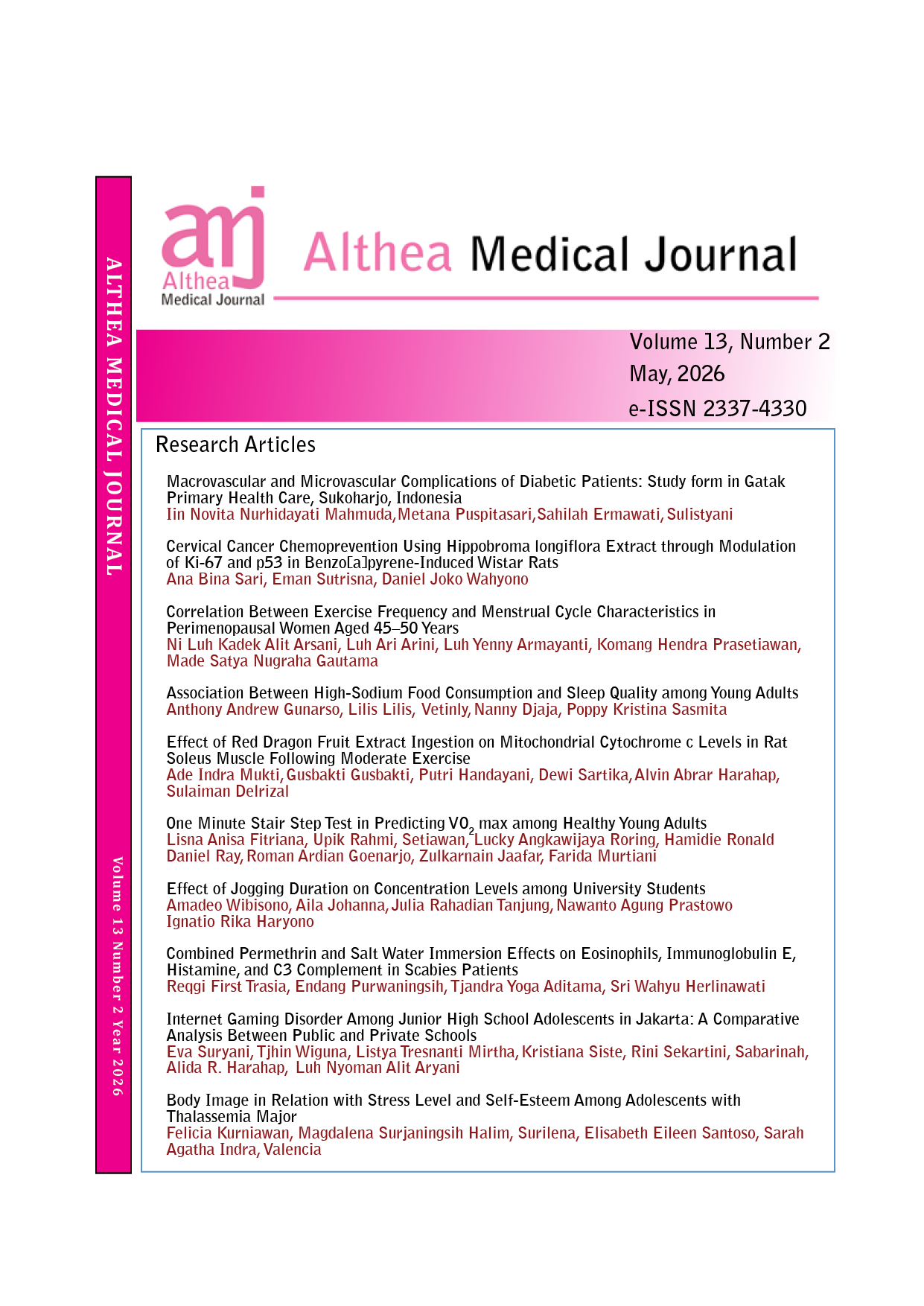
Correlation Between Exercise Frequency and Menstrual Cycle Characteristics in Perimenopausal Women Aged 45–50 Years
DOI:
https://doi.org/10.15850/amj.v13n2.4594Keywords:
Aging, exercise, menstrual cycle, perimenopause, premenopausal womenAbstract
Background: During perimenopause, declining estrogen levels often lead to altered menstrual patterns and other age-related health concerns. Consequently, the role of physical activity warrants closer examination. This study investigated the correlation between exercise frequency and menstrual cycle characteristics in premenopausal women
Methods: A cross-sectional observational study was conducted in Singaraja City, Indonesia, from July to October 2024. A total of 150 premenopausal women aged 45–50 years were recruited through random sampling. Exercise frequency was measured using the World Health Organization’s Global Physical Activity Questionnaire (GPAQ) and categorized as never, low (1–2 times/week), moderate (3–4 times/week), and high (>5 times/week). Menstrual cycle characteristics were assessed according to the International Federation of Gynecology and Obstetrics (FIGO) criteria, including cycle frequency, regularity, duration, and sanitary product use. Correlations between exercise frequency and menstrual parameters were analyzed using Spearman’s Rho test.
Results: Almost half of the women (45.3%) exercised 1–2 times/week. Interestingly, 22.0% never exercised. Moderate negative correlations were observed between exercise frequency and menstrual cycle period (r=-0.35, p<0.001) as well as regularity (r=-0.42, p<0.001). However, no significant correlation was found between exercise frequency and menstrual duration, and only a weak negative correlation with sanitary product use (r=-0.17, p=0.038).
Conclusions: Physical activity appears to modulate menstrual cycle patterns during perimenopause. Consequently, regular exercise may facilitate hormonal homeostasis and support reproductive health throughout the menopausal transition, ultimately enhancing overall quality of life
Downloads
References
- Santoro N, Roeca C, Peters BA, Neal-Perry G. The Menopause Transition: Signs, Symptoms, and Management Options. J Clin Endocrinol Metab. 2021;106(1):1–15. doi:10.1210/clinem/dgaa764
- Talaulikar V. Menopause transition: Physiology and symptoms. Best Pract Res Clin Obstet Gynaecol. 2022;81:3–7. doi:10.1016/j.bpobgyn.2022.03.003
- Munro MG, Critchley HOD, Fraser IS; FIGO Menstrual Disorders Committee. The two FIGO systems for normal and abnormal uterine bleeding symptoms and classification of causes of abnormal uterine bleeding in the reproductive years: 2018 revisions. Int J Gynaecol Obstet. 2018;143(3):393–408. doi:10.1002/ijgo.12666
- Ilankoon IMPS, Samarasinghe K, Elgán C. Menopause is a natural stage of aging: a qualitative study. BMC Womens Health. 2021;21(1):47. doi:10.1186/s12905-020-01164-6
- Rebelo-Marques A, De Sousa Lages A, Andrade R, Ribeiro CF, Mota-Pinto A, Carrilho F, et al. Aging hallmarks: the benefits of physical exercise. Front Endocrinol (Lausanne). 2018;9:258. doi:10.3389/fendo.2018.00258
- Passoni P, Inzoli A, De Ponti E, Longo S, Vaccari F, Galli M, et al. Association between physical activity and menstrual cycle disorders in young athletes. Int J Sports Med. 2024;45(7):543–8. doi:10.1055/a-2278-3253.
- Caldwell AE, Hooper PL. Sex hormones and physical activity in women: an evolutionary framework. In: Hackney AC, editor. Sex Hormones, Exercise and Women: Scientific and Clinical Aspects. Cham: Springer International Publishing; 2023:463–77. doi:10.1007/978-3-031-21881-1_20.
- Murray CM, Orr CJ. Hormonal regulation of the menstrual cycle and ovulation. In: Kovacs CS, Deal CL, editors. Maternal-Fetal and Neonatal Endocrinology: Physiology, Pathophysiology, and Clinical Management. MA: Academic Press; 2020. p. 159–67. doi:10.1016/B978-0-12-814823-5.00012-X
- Mizuta R, Maeda N, Komiya M, Yonezawa K, Kobayashi Y, Takahashi M, et al. The relationship between the severity of perimenstrual symptoms and a regular exercise habit in Japanese young women: a cross-sectional online survey. BMC Womens Health. 2022;22(1):200. doi:10.1186/s12905-022-01720-2.
- Hulteen RM, Marlatt KL, Allerton TD, Lovre D. Detrimental changes in health during menopause: the role of physical activity. Int J Sports Med. 2023;44(06):389–96. doi:10.1055/a-2003-9406
- Wu S, Shi Y, Zhao Q, Men K. The relationship between physical activity and the severity of menopausal symptoms: a cross-sectional study. BMC Womens Health. 2023;23(1):212. doi:10.1186/s12905-023-02347-7
- Gayatri S, Safitri A. Pengaruh Intensitas Olah Raga Terhadap Siklus Haid Atlet. Wal’afiat Hospital Journal. 2022;0(0 SE-Articles). doi:10.33096/whj.v0i0.64
- Keating XD, Zhou K, Liu X, Hodges M, Liu J, Guan J, et al. Reliability and concurrent validity of Global Physical Activity Questionnaire (GPAQ): a systematic review. Int J Environ Res Public Health. 2019;16(21):4128. doi:10.3390/ijerph16214128.
- Santoro N. Perimenopause: From Research to Practice. J Womens Health. 2015;25(4):332-339. doi:10.1089/jwh.2015.5556
- 15. Camaioni A, Ucci MA, Campagnolo L, De Felici M, Klinger FG, On behalf of the Italian Society of Embryology R and R (SIERR). The process of ovarian aging: it is not just about oocytes and granulosa cells. J Assist Reprod Genet. 2022;39(4):783–92. doi:10.1007/s10815-022-02478-0
- Grieger JA, Norman RJ. Menstrual Cycle Length and Patterns in a Global Cohort of Women Using a Mobile Phone App: Retrospective Cohort Study. J Med Internet Res. 2020;22(6):e17109. doi:10.2196/17109
- Paramsothy P, Harlow SD, Nan B, Greendale GA, Santoro N, Crawford SL, et al. Duration of the menopausal transition is longer in women with young age at onset: the multiethnic Study of Women’s Health Across the Nation. Menopause. 2017;24(2):142–9. doi:10.1097/GME.0000000000000716.
- Shahid W, Noor R, Bashir MS. Effects of exercise on sex steroid hormones (estrogen, progesterone, testosterone) in eumenorrheic females: A systematic to review and meta-analysis. BMC Womens Health. 2024;24(1):354. doi:10.1186/s12905-024-03203-y
- The hypothalamic-pituitary-ovarian axis, menstrual and oral contraceptive cycles: regulation and function in the context of exercise and sport. In: Hackney AC, editor. Sex Hormones, Exercise and Women: Scientific and Clinical Aspects. Cham: Springer International Publishing; 2023. p. 1–24. doi:10.1007/978-3-031-21881-1_1
- de Mendonça RMSC, de Araújo Júnior AT, de Sousa M do SC, Fernandes HM. The effects of different exercise programmes on female body composition. J Hum Kinet. 2014;43:67–78. doi:10.2478/hukin-2014-0091
- Bondarev D, Laakkonen EK, Finni T, Kokko K, Kujala UM, Aukee P, et al. Physical performance in relation to menopause status and physical activity. Menopause.2018;25(12):1432–41. doi:10.1097/GME.0000000000001237.
- McNulty KL, Elliott-Sale KJ, Dolan E, Swinton PA, Ansdell P, Goodall S, et al. The effects of menstrual cycle phase on exercise performance in eumenorrheic women: a systematic review and meta-analysis. Sports Med. 2020;50(10):1813–27. doi:10.1007/s40279-020-01319-3.
- Jacobs EA, Van Voorhis B, Kawwass JF, Kondapalli LA, Liu K, Dokras A. Endometrial thickness: How thin is too thin?. Fertil Steril. 2022;118(2):249–59. doi:10.1016/j.fertnstert.2022.05.033
- Hackney AC. Menstrual cycle hormonal changes and energy substrate metabolism in exercising women: a perspective. Int J Environ Res Public Health. 2021;18(19):10024. doi:10.3390/ijerph181910024
- Kanellakis S, Skoufas E, Simitsopoulou E, Apostolidou E, Goulis DG, Lambrinoudaki I, et al. Changes in body weight and body composition during the menstrual cycle. Am J Hum Biol. 2023;35(11):e23951. doi:10.1002/ajhb.23951.
- Sun J, Bai S, Li Q, Zhao M, Ge L, Zang S. The condition of women frequently changing sanitary pads in 28 cities of China: a cross-sectional study. Reprod Health. 2024;21(1):170. doi:10.1186/s12978-024-01910-1
- Kendall KL, Fairman CM. Women and exercise in aging. J Sport Health Sci. 2014;3(3):170–8. doi:https://doi.org/10.1016/j.jshs.2014.02.001
- 28. Ramadhana DR, Putra RP, Sibarani MA, Wibowo A, Pranoto A, Setiawan HK, et al. Short-term multicomponent exercise training improves executive function in postmenopausal women. PLoS One. 2024;19(8): e0307812. doi: 10.1371/journal.pone.0307812.
- Kistler-Fischbacher M, Weeks BK, Beck BR. The effect of exercise intensity on bone in postmenopausal women (part 2): A meta-analysis. Bone. 2021;143:115697. doi:https://doi.org/10.1016/j.bone.2020.115697
- Marsh ML, Oliveira MN, Vieira-Potter VJ. Adipocyte metabolism and health after the menopause: the role of exercise. Nutrients. 2023;15(2):444. doi:10.3390/nu15020444
Downloads
Published
Issue
Section
License
- Authors retain copyright and grant Althea Medical Journal right of first publication with the work simultaneously licensed under a Creative Commons Attribution License that allows others to freely share and remix the work with an acknowledgement of the work's authorship and initial publication in Althea Medical Journal. Althea Medical Journal is licensed under CC BY-NC 4.0
- Authors are permitted to copy and redistribute the journal's published version of the work non-commercially (e.g., post it to an institutional repository or publish it in a book), with an acknowledgment of its initial publication in Althea Medical Journal.